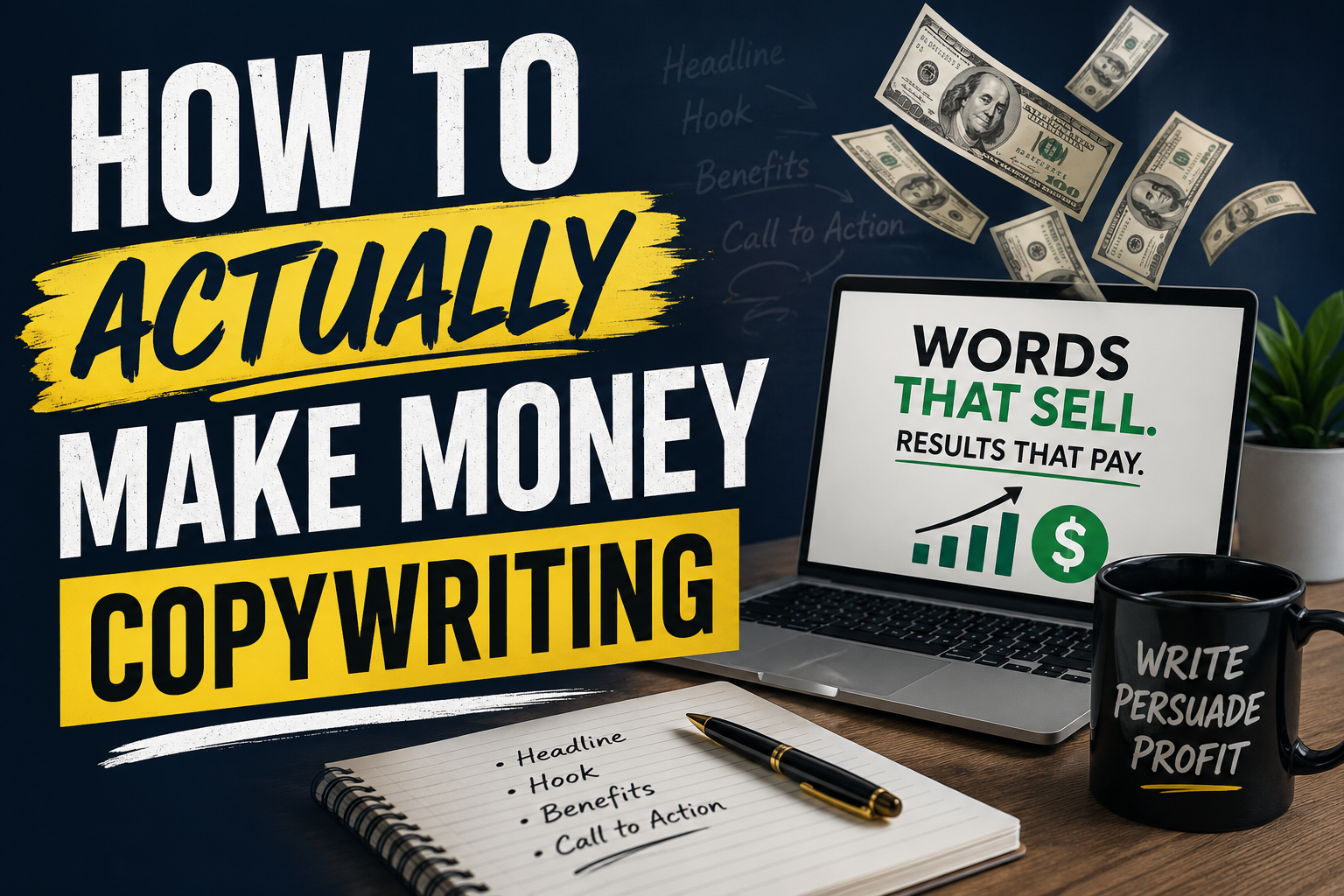
Copywriting is the highest-leverage form of writing online, and most people don't realize it because they confuse it with content writing. A blog post informs. A landing page, an email, or an ad has one job: make someone act. That difference — writing for action instead of just attention — is exactly why copywriters get paid more, sometimes dramatically more, than general writers for far less volume of work.
If freelance writing is about building an audience piece by piece, copywriting is about attaching your words directly to a business's revenue. That's a scarier proposition for beginners, but it's also why it pays so well once you know what you're doing.
What Copywriting Actually Is (and Isn't)
Copywriting is commercial writing meant to persuade someone to take a specific action: buy, sign up, click, subscribe, book a call. It's not the same skill as blogging or journalism, even though both involve writing well.
The main formats you'll be paid to write:
- Sales pages — long-form pages designed to convert a visitor into a buyer
- Email sequences — welcome sequences, abandoned cart emails, launch campaigns
- Ad copy — Facebook/Instagram ads, Google search ads, YouTube pre-roll scripts
- Landing pages — shorter, focused pages built around a single offer
- Product descriptions — especially for e-commerce brands that want conversion-focused copy, not generic specs
- Website copy — homepage, About page, service pages written to move visitors toward a decision
- Direct response letters — the classic long-form persuasive format, still used heavily in info products and coaching offers
Clients aren't paying you for pretty sentences. They're paying you because good copy measurably increases a number they care about — sales, sign-ups, click-through rate. That's the mental shift that separates copywriters who get repeat business from writers who stay stuck doing one-off gigs.
Step 1: Learn the Skill Before You Sell It
Copywriting has a real body of knowledge behind it, and skipping this step is why a lot of beginners struggle to land clients. You don't need a certification, but you do need to understand the fundamentals:
- Persuasion frameworks — AIDA (Attention, Interest, Desire, Action), PAS (Problem, Agitate, Solution), and the 4 Ps (Promise, Picture, Proof, Push) are starting points, not rigid formulas, but they teach you how persuasive structure actually works
- Voice of customer research — the best copy is often lifted almost directly from how real customers describe their problems, pulled from reviews, forums, and interviews, not invented from your own assumptions
- Headlines and hooks — most copy is skimmed, not read, so the first line has to earn the second
- Objection handling — anticipating the specific reasons someone won't buy, and addressing them before the reader has to ask
A good way to learn fast: study ads and emails you personally responded to. Screenshot them, break down why they worked, and rewrite them from scratch as practice. Swipe files (organized collections of proven copy examples) are a standard tool in this industry for exactly this reason.
Step 2: Pick a Format and an Industry to Start
Just like freelance writing, trying to be a generalist copywriter slows you down. Two decisions matter early on:
Pick a format to specialize in first — email copywriting tends to be the easiest entry point because it's lower-stakes than a full sales page and businesses need it constantly, not just once.
Pick an industry where copy has obvious ROI — some of the highest-paying niches for copywriters are:
- SaaS and tech companies (onboarding emails, landing pages)
- E-commerce and DTC brands (product pages, ad copy, abandoned cart flows)
- Coaching and info products (sales pages, launch emails)
- Health and wellness brands
- Financial services and fintech
You can specialize by format, industry, or both. "Email copywriter for SaaS companies" is a much easier sell than "copywriter."
Step 3: Build a Portfolio Without Client Work
Copywriting portfolios work differently than general writing portfolios — you're not just showing writing samples, you're showing strategic thinking. Build this before you pitch anyone:
- Pick 2–3 real companies in your chosen niche and rewrite one piece of their existing copy (an email, a landing page section, an ad) as a "before/after," with a short explanation of what you changed and why
- Write a full mock email sequence for a fictional or real product, showing the flow from welcome email to first offer
- Publish these on a simple portfolio site with the strategic reasoning included, not just the finished copy — clients want to see how you think, not just that you can write
This "spec work with a rationale" approach tends to land better than generic samples, because it proves you understand persuasion, not just prose.
Step 4: Find Clients Who Actually Value Copy
Copywriting clients skew more sophisticated than general content clients, which is good news — they already understand copy affects revenue, so you spend less time convincing them it matters.
Where to look:
- Marketing agencies that need overflow copywriting help (they often pay well and provide steady work)
- E-commerce brands running ads that could clearly use better copy — you'll spot these constantly once you start paying attention
- Direct outreach to SaaS and info-product companies with a specific rewrite of one of their existing assets attached
- Copywriting-specific job boards and communities (industry Slack groups and niche job boards tend to have higher-quality leads than general freelance marketplaces)
- Referrals from designers, web developers, and marketing consultants, who constantly need copywriters for client projects and don't want to write it themselves
A pitch structure that works well:
- Reference something specific about their current copy or offer
- Point out one clear opportunity (a weak headline, a missing objection handler, a CTA buried too low)
- Offer a short example or rewrite of that one section
- Ask if they'd like to talk about a full project
This works because it's specific and low-risk for the client to say yes to.
Step 5: Price Based on Impact, Not Word Count
This is where copywriting diverges hardest from general writing. A 500-word sales page that generates $50,000 in revenue is not priced the same as a 500-word blog post.
- Project-based pricing is standard — a sales page might run $1,500–$10,000+ depending on the business size and stakes
- Email sequences are often priced per email or as a bundled sequence, commonly $150–$500+ per email depending on experience and niche
- Retainers work well for ongoing email or ad copy needs, giving you predictable monthly income
- Performance-based bonuses (a base fee plus a percentage of increased conversions) can be lucrative once you have proof your copy performs, though most beginners should avoid these until they have a track record — it's a hard way to get paid if you're still learning
Resist quoting hourly. Copywriting value comes from the result, not the time spent, and clients who understand copywriting expect project or value-based pricing.
Step 6: Track Results and Let Them Sell for You
The single biggest lever for raising your rates in copywriting is proof of results. Ask clients (politely, after delivery) if they're willing to share performance data — conversion rate, open rate, revenue lift. Even directional numbers ("increased email open rate by 22%") are powerful in a portfolio and pitch.
Over time, this turns your portfolio from "here's writing I did" into "here's revenue I generated," which is a completely different — and far more convincing — sales pitch for future clients.
The Realistic Timeline
- Months 1–2: learning frameworks, building spec samples, first small gigs (often email work)
- Months 3–6: landing first real clients, refining a niche, starting to gather results data
- Months 6–12: results-backed portfolio, higher-ticket projects, first retainer clients
- Year 1+: established niche reputation, referral-driven pipeline, rates well above content-writing averages
Final Thought
Copywriting rewards people who think like marketers, not just writers. If you can understand what makes someone click "buy," and you're willing to learn the frameworks instead of relying on natural talent alone, this is one of the fastest paths from freelance beginner to serious income online — because you're not just writing words, you're writing outcomes.
0 Comments
Leave a comment